From data sovereignty and lower operating costs to reproducible research and technological independence: how open AI models are reshaping education, public administration, and enterprise software.
The most powerful AI model is not always the best choice
Artificial intelligence is often presented as a competition between increasingly powerful language models. Every new release brings benchmark results, demonstrations of advanced reasoning, and claims of superior coding performance.
For experienced software developers, however, the central question is different. Which model can be reliably integrated into an application, deployed within a controlled environment, adapted to specific requirements, and maintained without creating excessive costs or long-term dependencies?
This explains the growing importance of open-source and open-weight AI models.
Their attraction is not simply that model weights can be downloaded. It is that developers can gain greater control over deployment, customization, performance optimization, and infrastructure decisions.
Open models provide sufficient capability to become the preferred engineering choice for specific production workloads.
Six reasons experienced developers prefer open AI
The first reason is control over data and infrastructure.
Organizations processing confidential documents, student information, financial records, or government data may need to keep information within their own infrastructure. Self-hosted models make it possible to process sensitive information without routinely transmitting it to an external inference provider.
Local deployment does not automatically guarantee security or regulatory compliance. Nevertheless, it gives organizations more direct control over access policies, logging, retention, and network boundaries.
The second reason is avoiding vendor lock-in.
Applications built exclusively around proprietary APIs may become dependent on a provider’s pricing, availability, model updates, and contractual conditions. Open-weight models, combined with standardized interfaces, allow developers to replace inference engines or models without rebuilding entire applications.
The third reason is cost predictability.
Commercial AI services commonly charge according to usage. Self-hosted systems have different economics, involving hardware, electricity, maintenance, and engineering expertise.
For organizations processing large, predictable workloads, optimized open models can reduce the marginal cost of inference. For smaller or irregular workloads, commercial APIs may remain more economical. Experienced developers therefore evaluate total cost of ownership rather than assuming that open models are always cheaper.
The fourth reason is customization.
Open weights enable fine-tuning, quantization, model distillation where licensing permits, and optimization for specific hardware. Retrieval-augmented generation allows organizations to connect models to trusted institutional knowledge without retraining the entire system.
The fifth reason is reproducibility.
Developers can pin model versions, maintain stable evaluation environments, and investigate failures systematically. Fully open models go further by publishing training code, datasets, intermediate checkpoints, and evaluation procedures.
The sixth reason is institutional capability.
Organizations operating their own AI systems develop expertise in data engineering, model evaluation, infrastructure management, and AI governance. This expertise becomes an enduring asset rather than remaining entirely with an external technology provider.
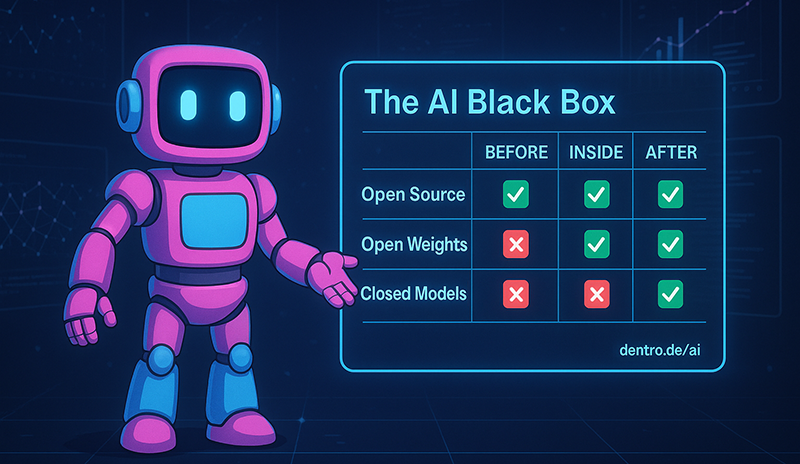
Open-source and open-weight are not the same
An important distinction is frequently overlooked.
An open-weight model provides access to its trained parameters, subject to its license. This does not necessarily mean that its training datasets, complete source code, or training procedures are publicly available.
Fully open models aim to provide broader transparency across the development process.
The OLMo family, developed by the Allen Institute for AI, is a particularly important example. It provides access to training resources, model checkpoints, evaluation methods, and supporting code.
The European Apertus initiative similarly emphasizes transparent, multilingual AI development.
By contrast, several commercially significant open-weight families provide extensive deployment flexibility without necessarily disclosing everything required to reproduce their training.
For research institutions, this distinction is fundamental. Access to model weights enables experimentation, but access to the complete development process supports deeper scientific scrutiny.
Which open models deliver the strongest benchmark performance?

The open-model ecosystem includes several families capable of handling sophisticated reasoning, programming, and multilingual tasks.
Qwen models are notable for their range of sizes and capabilities, including coding, mathematical reasoning, and multilingual applications.
DeepSeek demonstrated how advanced reasoning capabilities could be developed using reinforcement learning and efficient model architectures.
Kimi and GLM have emerged as important alternatives for coding, tool use, and complex agentic workflows. Their suitability depends on the particular release, available weights, deployment requirements, and license.
Mistral provides European alternatives spanning compact models and larger systems designed for demanding workloads.
Llama remains influential because of its extensive developer ecosystem, although its community licenses should not automatically be treated as conventional open-source licenses.
OLMo and Apertus are particularly relevant where transparency, research reproducibility, and institutional independence matter as much as raw benchmark performance.
No single family is the best choice for every task.
SWE-bench Verified evaluates systems attempting to resolve real software engineering issues. LiveCodeBench focuses on programming problems. GPQA Diamond measures performance on demanding scientific questions, while MMLU-Pro evaluates broader knowledge and reasoning.
These benchmarks measure different capabilities. Results may also depend on inference settings, tool access, prompting strategies, and the evaluation framework.
Consequently, a claim that one model is the strongest open model must identify its exact version, benchmark, evaluation date, and configuration.
For production deployments, the more important metric is often the cost of successfully completing a real task.
Education: AI as an institutional learning resource
Open models offer educational institutions an opportunity to develop AI systems adapted to their curricula, languages, and teaching methods.
A university can operate a research assistant connected to its digital library. A school can develop a learning assistant that explains mathematical concepts using approved educational material. A vocational institution can build specialized tools for technical training.
The Allen Institute for AI provides a concrete example of an operational research ecosystem built around openly available models, training resources, and evaluation infrastructure.
Hugging Face provides another important example of infrastructure used in practical research, teaching, and model development workflows.
These are established operational platforms. They should not, however, be confused with verified evidence that a particular language model has been deployed across an entire national school system.
The distinction matters because educational AI requires more than technically successful inference. Institutions must evaluate factual accuracy, accessibility, age appropriateness, pedagogical value, privacy, and the continued responsibility of teachers.
The strongest educational use cases are those where AI supports learning rather than replacing educational judgment.
Public administration: the French Albert initiative
One of the most relevant public-sector examples is Albert, developed within France’s public digital administration ecosystem.
Albert is designed to help public employees access and use information from official administrative sources. Its publicly available software components demonstrate an approach based on reusable technology, institutional knowledge, and greater control over public-sector AI infrastructure.
Different Albert components and deployments have different levels of operational maturity. Publicly available source code alone does not establish nationwide production deployment.
Nevertheless, the initiative illustrates a significant architectural choice.
Instead of purchasing separate proprietary AI assistants for every public agency, governments can invest in shared infrastructure, reusable components, and systems grounded in authoritative administrative documents.
For public services, retrieval-augmented generation is especially important. Answers concerning legislation, eligibility, permits, or administrative obligations should reference authoritative sources rather than rely solely on information stored in a model’s parameters.
Human oversight remains essential, particularly where AI outputs could affect citizens’ rights.
Enterprises: controlling AI across the software lifecycle
Businesses are increasingly interested in AI systems that integrate directly into existing software development, document management, customer support, and knowledge management workflows.
GitLab Duo Self-Hosted provides a concrete enterprise product example. Its architecture supports AI functionality in environments where organizations require greater control over infrastructure and model selection.
Its documentation includes compatible model families and hardware requirements, demonstrating that self-hosted AI has become a supported enterprise deployment option rather than merely an experimental practice.
Another important example is vLLM, an open-source inference engine designed for efficient model serving.
Its production stack supports deployment on Kubernetes, monitoring, routing, and scalable inference. Such technologies enable organizations to operate open models as managed services within their existing infrastructure.
However, the existence of a production-ready platform should not be confused with evidence that every supported model has been independently validated in every business setting.
For enterprises, the real benefits come from matching the model to the workload.
A smaller specialized model may be preferable for document classification, while a more capable reasoning model may be needed for software engineering or complex analysis.
The optimal architecture may combine multiple models, using different systems according to task complexity, privacy requirements, and cost.
Why multilingual AI changes the equation
Most internationally recognized AI benchmarks emphasize English or a relatively small set of widely represented languages.
This creates a significant problem for countries whose administrative, legal, educational, and scientific information is primarily available in other languages.
A model that performs exceptionally well on English programming benchmarks may struggle with Greek legislation, specialized scientific terminology, or complex administrative documents.
The solution is not necessarily to train an entirely new national foundation model.
A more practical strategy is to evaluate strong existing open models, connect them to high-quality local knowledge, and improve their performance through carefully governed adaptation.
This approach creates opportunities for smaller countries to participate actively in AI development without replicating the enormous training expenditures of the largest technology companies.
GlossAPI and the opportunity for Greek-language AI
GlossAPI illustrates how an open data and evaluation ecosystem can contribute to this transformation.
Its strategic value lies in developing Greek-language resources, supporting model evaluation, and enabling researchers and organizations to build applications adapted to real Greek-language tasks.
Potential applications include administrative document analysis, educational assistance, scientific literature exploration, and retrieval from authoritative public information.
The decisive requirement is systematic evaluation.
Models should be compared using representative Greek datasets and realistic workloads, measuring factual accuracy, source attribution, latency, operating costs, and failure rates.
Such evaluations can help identify when a compact model is sufficient, when a larger open-weight model is justified, and when a proprietary alternative delivers measurable additional value.
This approach also supports cooperation between universities, public institutions, open-source communities, and businesses.
From AI consumption to technological capability
The most important advantage of open AI is not that every organization can own a copy of a powerful model.
It is that organizations can retain meaningful control over how AI systems are built, evaluated, operated, and improved.
Open models enable a different relationship between technology providers and users. Institutions can invest in reusable infrastructure, share technical knowledge, improve transparency, and reduce unnecessary dependencies.
For education, this can mean learning tools adapted to local needs. For governments, it can mean accountable digital public infrastructure. For businesses, it can mean greater flexibility, predictable operating costs, and stronger internal capabilities.
The future of AI will not be determined solely by which company develops the most powerful model. It will also depend on who can understand, adapt, operate, and govern the technology.
That is why open-source and open-weight AI models have become strategically important, not only to experienced developers, but to the institutions and societies that increasingly depend on artificial intelligence.