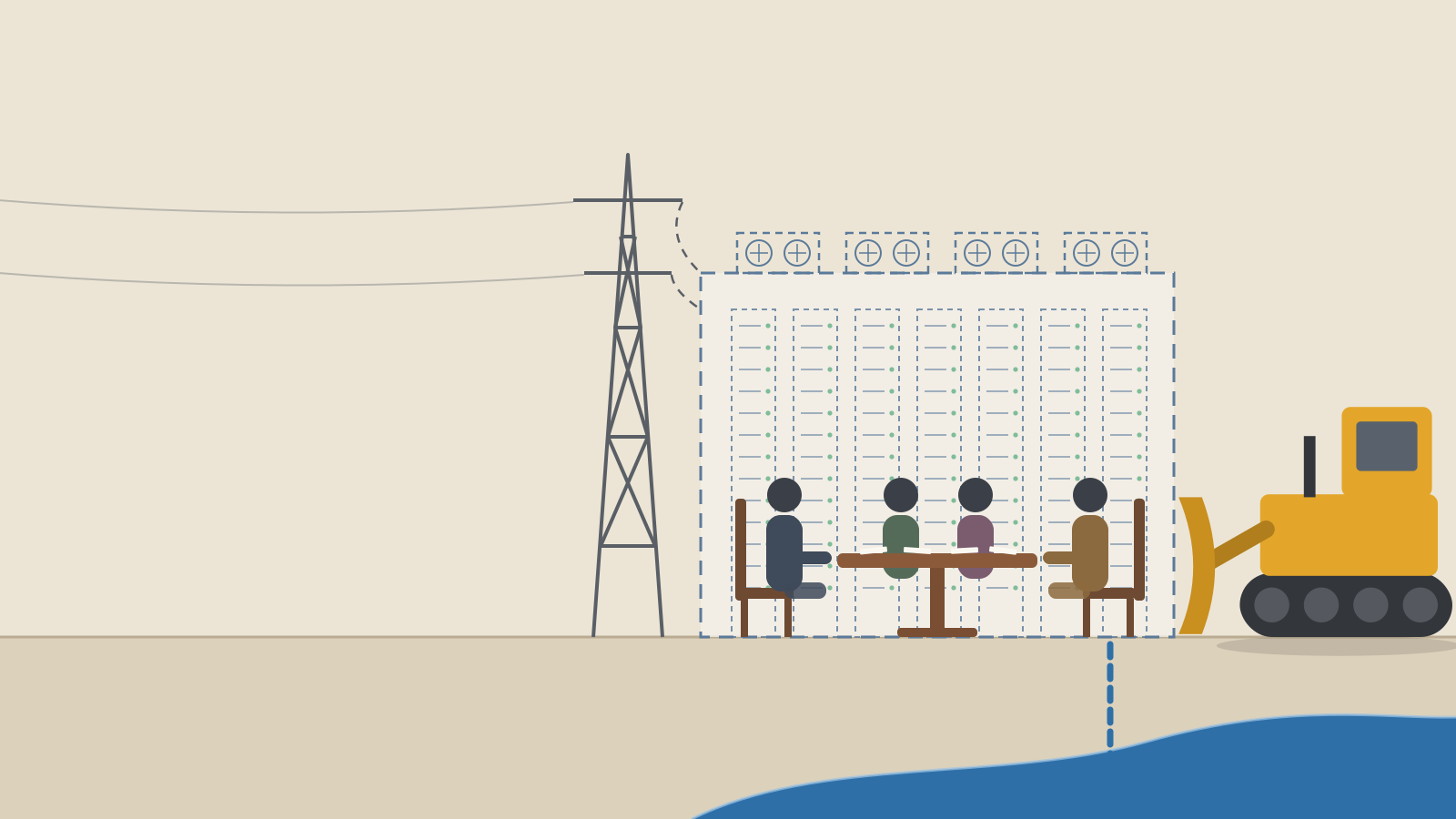
In less than a year, the debate over data centres in the United States has changed venue. It left investor presentations, entered city council chambers and, more and more often, reached the ballot box. In June, voters in Monterey Park, California, approved a permanent ban on new data centres with 86% of the vote. In July, New York temporarily froze permits for large facilities across the state by executive order, and at least a hundred cities and counties have now adopted some form of moratorium. It would be convenient to read all this as technophobia. Anyone who reads the two most recent texts on the subject, a guide from the Federation of American Scientists (FAS) and a paper from a Brookings working group, sees something more mundane, and for that reason more serious: local communities discovering that decisions about their water, their electricity and their land have already been taken somewhere else.
What you find when you open the contracts
The FAS guide for local governments, Before Breaking Ground, was published in September. Of the 42 local ordinances it tracked, 33 were passed in 2026 alone, compared with two in 2024. The most interesting part of the work lies elsewhere, though. The researchers went looking for the agreements that municipalities sign with developers, which are rarely published and often covered by confidentiality clauses, and managed to obtain ten, mostly through public records requests. Only one of them, in Lancaster, Pennsylvania, was written explicitly as a community benefits agreement.
Reading them is instructive. Almost all of them are about money: tax abatements, rebates and contributions to local funds. Far fewer bind the developer on water, energy or noise, and none contains binding employment commitments, only projections. In Cedar Rapids, Iowa, the city rebates 70% of property tax for twenty years, an estimated $529 million, in exchange for an $18 million community betterment fund. In DeKalb, Illinois, building plans are classed as confidential, and when a resident asks for documents, the city must first give the company time to review the request, make redactions or decline to release certain information.
FAS ends with two recommendations worth keeping. The first is that every community should decide whether, where and on what terms it wants data centres before it sits down with a developer. The second is that no tax incentive should be granted without the option to renegotiate within five years, since, as the authors themselves admit, nobody yet knows how the economics of these facilities will develop.
A negotiation between unequals
The second text, from a Brookings working group whose members include Scott Page and Jacob Taylor, gives a name to what FAS describes with numbers: mismatched agency. On one side sits a local official, often part-time, negotiating one approval at a time; on the other, experienced corporate lawyers applying pressure with deadlines and non-disclosure agreements. Residents learn the terms when the deal is nearly done, and the suspicion that follows easily merges with wider fears about artificial intelligence.
Their proposal sounds paradoxical at first, since they ask communities to use AI itself to deliberate better. In a simulation set in a fictional Michigan county, three groups of residents started from different priorities: economic development, watershed protection and affordable power and water. Mapped against the Sustainable Development Goals, the three proposals shared just one sub-target. When the participants’ own interviews were mapped, however, the overlaps exceeded a dozen, led by transparency, trust and inclusive decision-making. The group settled on mandatory disclosure of water and energy use, enforceable benefit agreements, a community stake in the project and joint planning for water and energy.
The authors are candid about the limits of the exercise: two meetings of experts, broadly sympathetic to the technology, with nothing real at stake. Just as interesting is their insistence that the tools should belong to the communities themselves, be hosted locally and be released as open source, following the distribution model of Consul Democracy, so that decisions about who convenes, who takes part and where the data is kept are not taken somewhere else. They also recall that Toronto’s smart waterfront project was abandoned in 2020 over precisely this question.
And in Greece?
One could argue that all this concerns another continent. Yet Greece is acquiring exactly the same problem, with the difference that Greek municipalities have far fewer tools than an American city council. Law 5069/2023 and Joint Ministerial Decision 96038/2024, in force since March 2025, defined the data centre in Greek law for the first time and placed its operation under the notification regime of Law 4442/2016, a system in which the operator declares the activity and checks generally come afterwards. The government presented this as a step towards making the country a digital hub, and the figures show how large the ambition is. According to a PwC study for the government, as cited in a recent parliamentary question, demand from data centres could reach 2.5 to 2.8 GW by 2034, or as much as 5.7 GW in a rapid-growth scenario. For a sense of scale, an industry executive said this year that data centres currently account for about 0.1% of the country’s total electricity demand.
The same question, tabled in August by Evangelia Liakouli, an MP for Larissa, cites an estimate by IPTO, the Greek transmission system operator, of up to 650 MW of capacity available for data centres in Thessaly, along with press reports of a facility of more than 200 MW near Larissa’s industrial zone. Thessaly is a region still living with water scarcity and the damage of recent devastating floods, and the question complains that neither the regional authority, nor the municipalities, nor the Technical Chamber of Greece, the Geotechnical Chamber or the local chambers of commerce have been formally informed. These questions, how much water, from which source, with what cooling technology and on which plot of land, carry no party label. They are exactly the ones FAS advises every community to have answered before it reaches the table.
What deciding before the bulldozers arrive would mean
If we try to keep from the American experience whatever travels well, some steps are simple enough that, with a little will, they could be taken tomorrow. Data centre notifications could be kept in a public, machine-readable register listing each facility’s capacity, cooling technology and water source, with annual reporting of actual consumption, so that anyone interested can check what the developer promised. The idea is not new: the lack of standardised, facility-level reporting was the complaint FAS heard most often from water utilities.
Any agreement involving public land, grid infrastructure or tax incentives should be published in full, because the terms on which shared resources are made available can hardly stand as trade secrets. Siting, meaning the energy map of where such facilities may be located, should go through open consultation with regional authorities, municipalities and scientific bodies before major projects are set in motion, and any incentives granted should come with a review clause, as FAS recommends. None of this is directed against investment. A developer who knows the terms from the start, facing a community that helped shape them, runs a far smaller risk over a project lasting decades than one facing a last-minute referendum like Monterey Park’s.
Most citizens will first encounter artificial intelligence through something tangible: a plot in their town’s industrial zone, a new high-voltage line, perhaps a rise in their water bill. That experience is what they will use to decide whether to trust it, long before they open the EU AI Act. Who decides about data centres is therefore the first practical question of AI governance that Greek society will face, and it would be wise to answer it while there is still time to answer it together.